George Sale, The Koran, commonly called the Alcoran of Mohammed, translated into English immediately from the original Arabic; with Explanatory Notes, taken from the most approved Commentators. To which is prefixed A Preliminary Discource (1734)
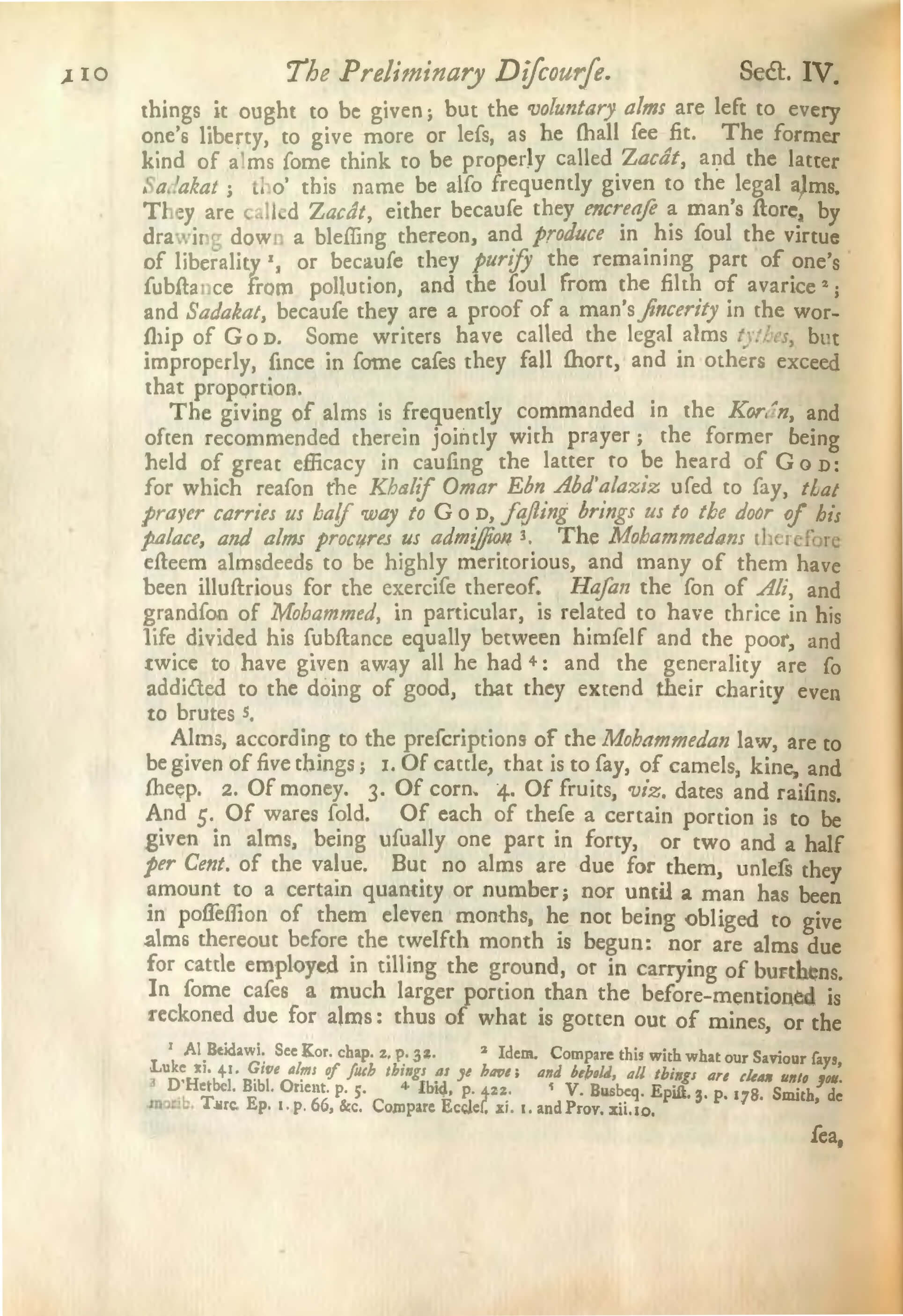
things it ought to be given; but the voluntary alms are left to every one’s liberty, to give more or less, as he shall see fit. The former kind of alms some think to be properly called Zacât, and the latter Sadakat; tho’ this name be also frequently given to the legal alms. They are called Zacât, either because they encrease a man’s store, by drawing down a blessing thereon, and produce in his soul the virtue of liberality 1, or because they purify the remaining part of one’s substance from pollution, and the soul from the filth of avarice 2; and Sadakat, because they are a proof of a man’s sincerity in the worship of God. Some writers have called the legal alms tythes, but improperly, since in some cases they fall short, and in others exceed that proportion.
The giving of alms is frequently commanded in the Korân, and often recommended therein jointly with prayer; the former being held of great efficacy in causing the latter to be heard of God: for which reason the Khalif Omar Ebn Abd’alaziz used to say, that prayer carries us half way to God, fasting brings us to the door of his palace, and alms procures us admission 3. The Mohammedans therefore esteem almsdeeds to be highly meritorious, and many of them have been illustrious for the exercise thereof. Hasan the son of Ali, and grandson of Mohammed, in particular, is related to have thrice in his life divided his substance equally between himself and the poor, and twice to have given away all he had 4: and the generality are so addicted to the doing of good, that they extend their charity even to brutes 5.
Alms, according to the prescriptions of the Mohammedan law, are to be given of five things; 1. Of cattle, that is to say, of camels, kine, and sheep. 2. Of money. 3. Of corn. 4. Of fruits, viz. dates and raisins. And 5. Of wares sold. Of each of these a certain portion is to be given in alms, being usually one part in forty, or two and a half per Cent, of the value. But no alms are due for them, unless they amount to a certain quantity or number; nor until a man has been in possession of them eleven months, he not being obliged to give alms chereout before the twelfth month is begun: nor are alms due for cattle employed in tilling the ground, or in carrying of burthens. In some cases a much larger portion than the before-mentioned is reckoned due for alms: thus of what is gotten out of mines, or the
1 Al Beidawi. See Kor. chap. 2. p. 32.
2 Idem. Compare this with what our Saviour says, Luke xi. 41. Give alms of such things as ye have; and behold, all things are clean unto you.
3 D’Herbel. Bibl. Orient. p. 5.
4 Ibid, p. 422.
5 V. Busbeq. Epist. 3. p. 178. Smith, de morib. Turc. Ep. 1. p. 66, &c. Compare Eccles. xi. 1. and Prov. xii.co.