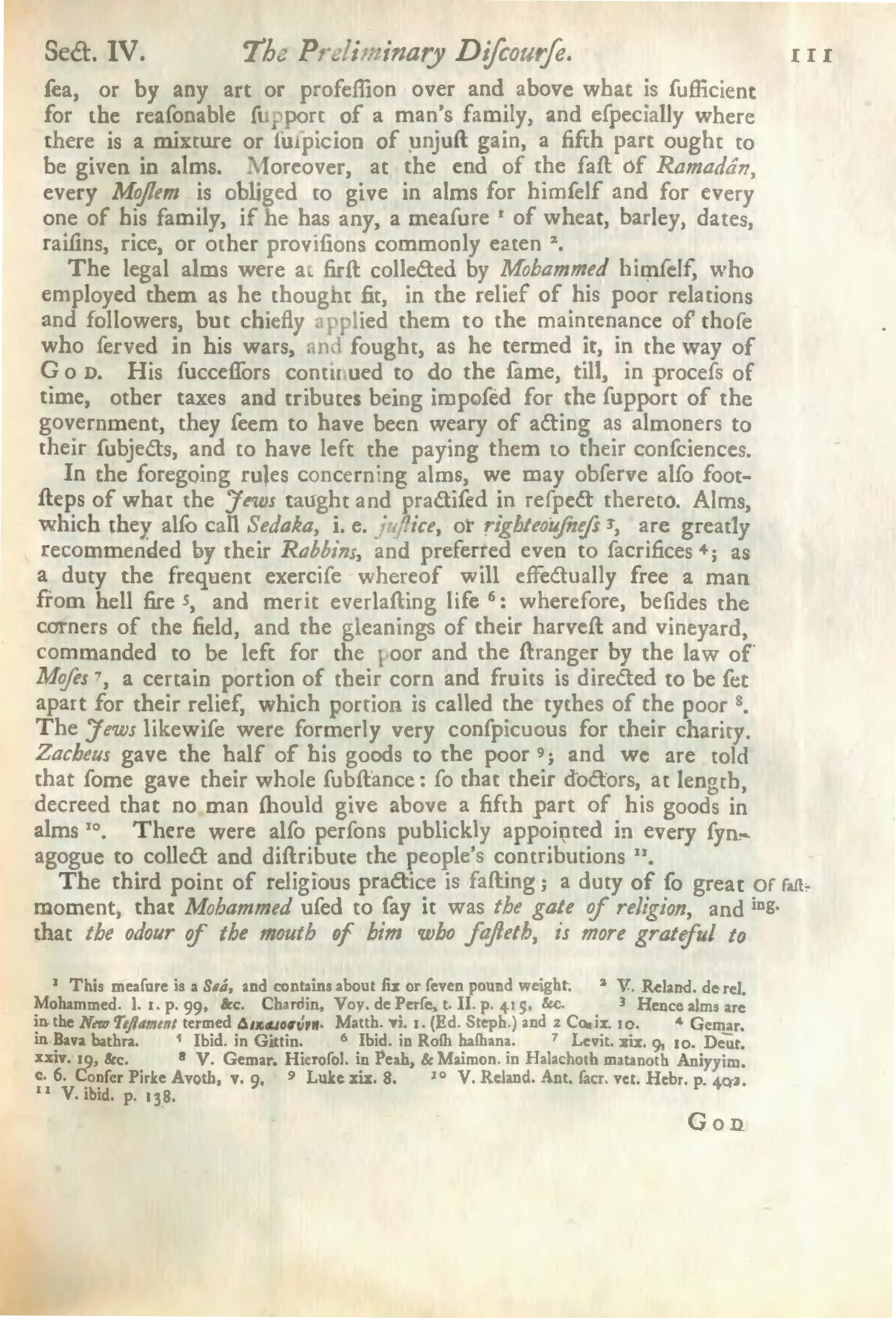
George Sale, The Koran, commonly called the Alcoran of Mohammed, translated into English immediately from the original Arabic; with Explanatory Notes, taken from the most approved Commentators. To which is prefixed A Preliminary Discource (1734)
sea, or by any art or profession over and above what is sufficient for the reasonable support of a man’s family, and especially where there is a mixture or suspicion of unjust gain, a fifth part ought to be given in alms. Moreover, at the end of the fast of Ramadân, every Moslem is obliged to give in alms for himself and for every one of his family, if he has any, a measure 1 of wheat, barley, dates, raisins, rice, or other provisions commonly eaten 2.
The legal alms were at first collected by Mohammed himself, who employed them as he thought fit, in the relief of his poor relations and followers, but chiefly applied them to the maintenance of those who served in his wars, and fought, as he termed it, in the way of God. His successors continued to do the same, till, in process of time, other taxes and tributes being imposed for the support of the government, they seem to have been weary of acting as almoners to their subjects, and to have left the paying them to their consciences.
In the foregoing rules concerning alms, we may observe also footsteps of what the Jews taught and practised in respect thereto. Alms, which they also call Sedaka, i.e. justice, or righteousness 3, are greatly recommended by their Rabbins, and preferred even to sacrifices 4; as a duty the frequent exercise whereof will effectually free a man from hell fire 5, and merit everlasting life 6: wherefore, besides the corners of the field, and the gleanings of their harvest and vineyard, commanded to be left for the poor and the stranger by the law of Moses 7, a certain portion of their corn and fruits is directed to be set apart for their relief, which portion is called the tythes of the poor 8. The Jews likewise were formerly very conspicuous for their charity. Zacbeus gave the half of his goods to the poor 9; and we are told that some gave their whole substance: so that their doctors, at length, decreed that no man should give above a fifth part of his goods in alms 10. There were also persons publickly appointed in every synagogue to collect and distribute the people’s contributions 11.
Of fasting.
The third point of religious practice is fasting; a duty of so great moment, that Mohammed used to say it was the gate of religion, and that the odour of the mouth of him who fasteth, is more grateful to
1 This measure is a Saá, and contains about six or seven pound weight.
2 V. Reland: de rel. Mohammed. 1. 1. p. 99, &c. Chardin, Voy. de Perse, t. II. p. 415, &c.
3 Hence alms are in the New Testament termed Δικαιοσύνη. Matth. vi. 1. (Ed. Steph.) and 2 Co. ix. 10.
4 Gemar. in Bava bathra.
5 Ibid. in Gittin.
3 Ibid. in Rosh hashana.
3 Levit. xix. 9, 10. Deut. xxiv. 19, &c.
3 V. Gemar. Hierosol. in Peah, & Maimon. in Halachoth matanoth Aniyyim. c. 6. Confer Pirke Avoth, v. 9.
3 Luke xix, 8.
3 V. Reland. Ant, facr. vet. Hebr. p. 402.
3 V. ibid. p. 138.