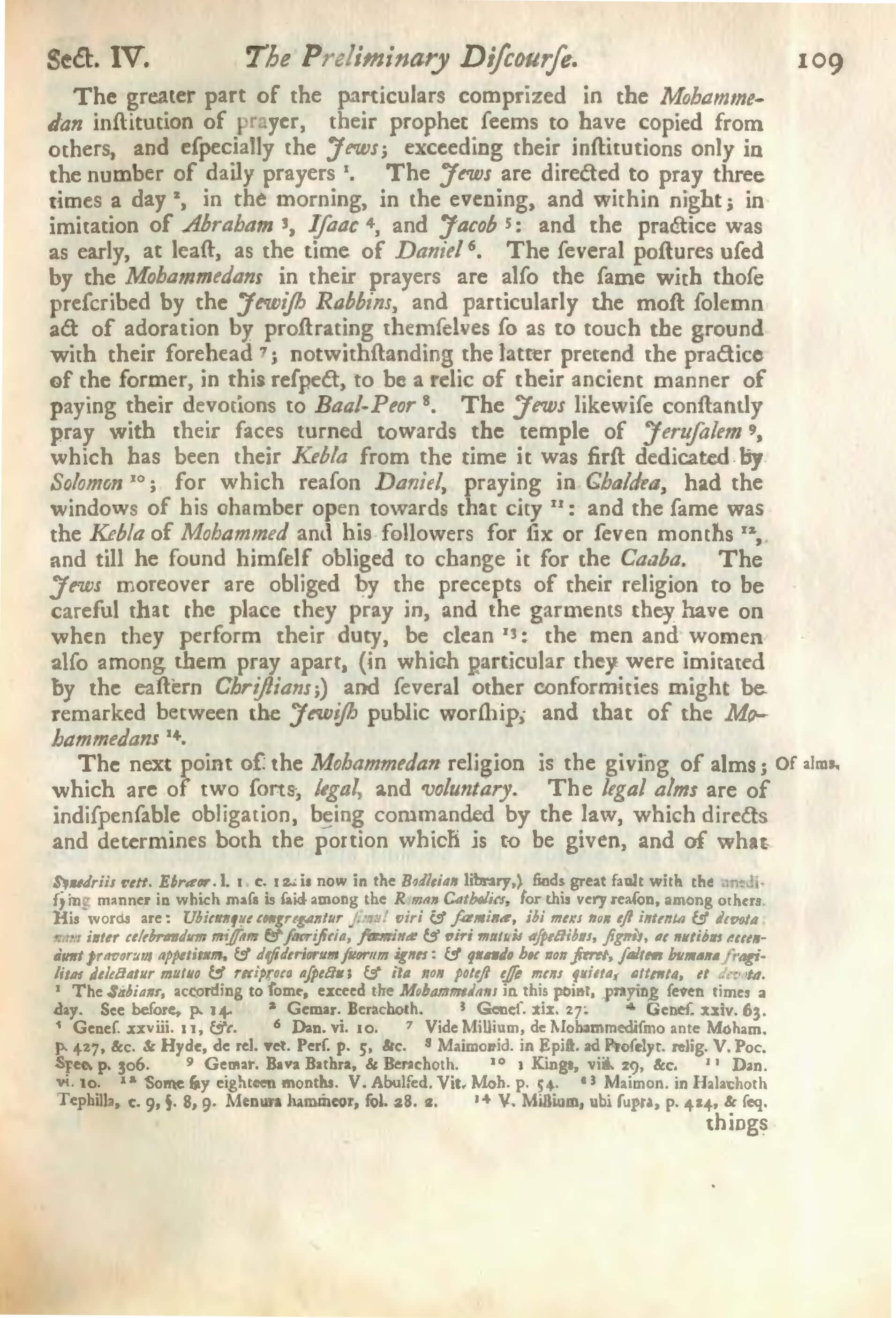
George Sale, The Koran, commonly called the Alcoran of Mohammed, translated into English immediately from the original Arabic; with Explanatory Notes, taken from the most approved Commentators. To which is prefixed A Preliminary Discource (1734)
The greater part of the particulars comprized in the Mohammedan institution of prayer, their prophet seems to have copied from others, and especially the Jews; exceeding their institutions only in the number of daily prayers 1. The Jews are directed to pray three times a day 2, in the morning, in the evening, and within night; in imitation of Abraham 3, Isaac 4, and Jacob 5; and the practice was as early, at least, as the time of Daniel 6. The several postures used by the Mohammedans in their prayers are also the same with those prescribed by the Jewish Rabbins, and particularly the most solemn act of adoration by prostrating themselves so as to touch the ground with their forehead 7; notwithstanding the latter pretend the practice of the former, in this respect, to be a relic of their ancient manner of paying their devotions to Baal-Peor 8. The Jews likewise constantly pray with their faces turned towards the temple of Jerusalem 9, which has been their Kebla from the time it was first dedicated by Solomon 10; for which reason Daniel, praying in Chaldea, had the windows of his chamber open towards that city 11: and the same was the Kebla of Mohammed and his followers for six or seven months 12, and till he found himself obliged to change it for the Caaba. The Jews moreover are obliged by the precepts of their religion to be careful that the place they pray in, and the garments they have on when they perform their duty, be clean 13: the men and women also among them pray apart, (in which particular they were imitated by the eastern Christians;) and several other conformities might be remarked between the Jewish public worship, and that of the Mohammedans 4.
Of alms.
The next point of the Mohammedan religion is the giving of alms; which are of two sorts, legal, and voluntary. The legal alms are of indispensable obligation, being commanded by the law, which directs and determines both the portion which is to be given, and of what
← Synedriis vett. Ebræor. l. 1. c. 12. is now in the Bodleian library,) finds great fault with the unedifying manner in which mass is said among the Roman Catholics, for this very reason, among others. His words are: Ubicunque congregantur simul viri & fæminæ, ibi mens non est intenta & devota: nam inter celebrandum missam es sacrificia, fæminæ & viri mutuis aspectibus, signis, at nutibus accendunt pravorum appetitum, & desideriorum suorum ignes: & quando hoc non fieret, saltem humana fragilitas delictarur mutuo & reciproco aspectu; & ita non potest esse mens quieta, attenta, et devota.
1 The Sabians, according to some, exceed the Mohammedans in this point, praying seven times a day. See before, p. 14.
2 Gemar. Berachoth.
3 Genes. xix. 27.
4 Genes. xxiv. 63.
5 Genes. xxviii. 11, &c.
6 Dan. vi. 10.
7 Vide Millium, de Mohammedismo ante Moham. p. 427, &c. & Hyde, de rel. vet. Pers. p. 5, &c.
8 Maimonid. in Epist. ad Proselyt. relig. V. Poc. Spec. p. 306.
9 Gemar. Bava Bachra, & Berachoth.
10 1 Kings, viii. 29, &c.
11 Dan. vi. 10.
12 Some say eighteen months. V. Abulfed. Vit. Moh. p. 54.
13 Maimon. in Halachoth Tephilla,. c. 9, §. 8, 9. Menura hammeor, fol. 28. 2.
14 V. Miilium, ubi supra, p. 424, & feq.