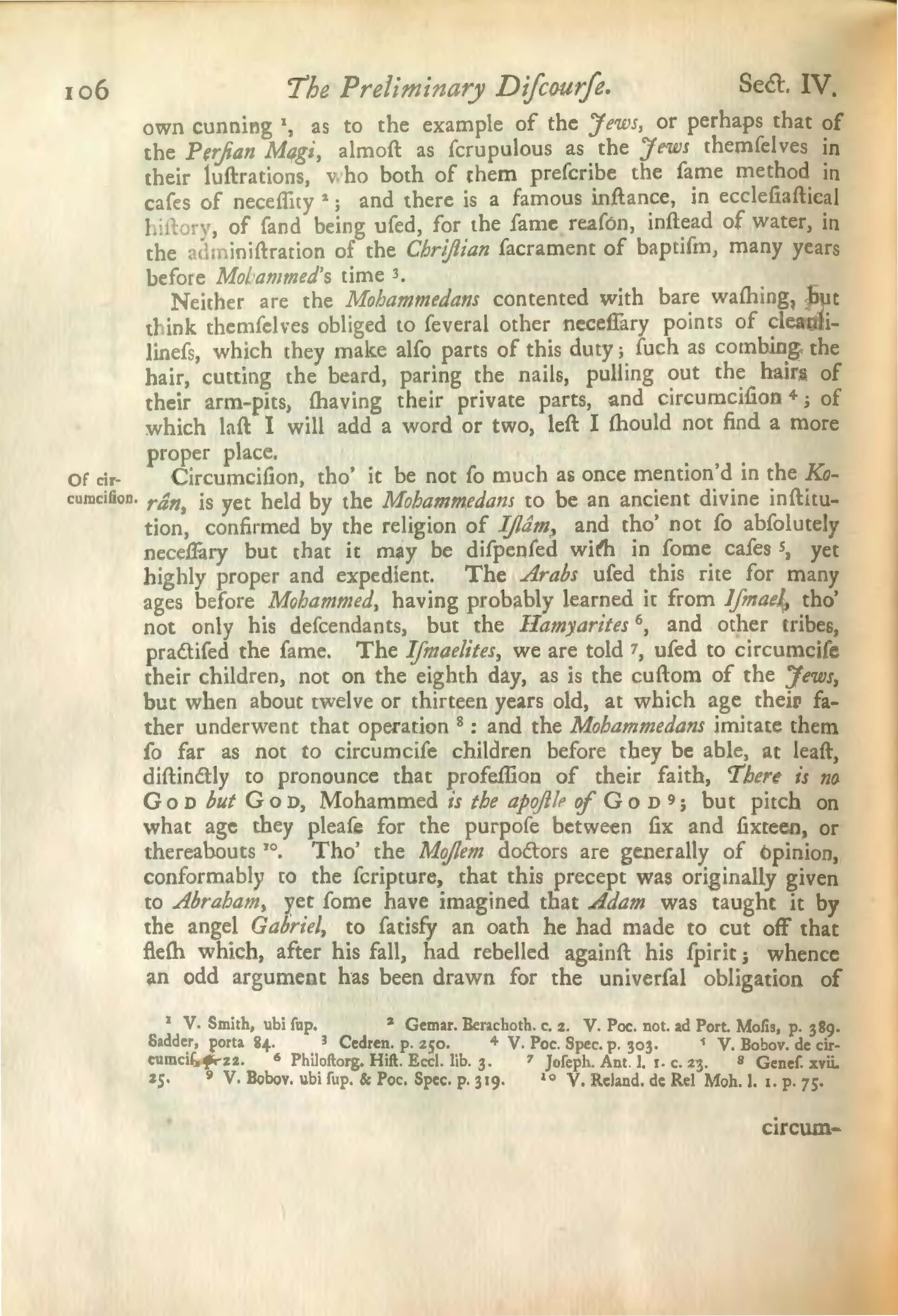
George Sale, The Koran, commonly called the Alcoran of Mohammed, translated into English immediately from the original Arabic; with Explanatory Notes, taken from the most approved Commentators. To which is prefixed A Preliminary Discource (1734)
own cunning 1, as to the example of the Jews, or perhaps that of the Persian Magi, almost as scrupulous as the Jews themselves in their lustrations, who both of them prescribe the same method in cases of necessity 2; and there is a famous instance, in ecclesiastical history, of sand being used, for the same reason, instead of water, in the administration of the Christian sacrament of baptism, many years before Mobammed’s time 3.
Neither are the Mohammedans contented with bare washing, but think themselves obliged to several other necessary points of cleanliliness, which they make also parts of this duty; such as combing the hair, cutting the beard, paring the nails, pulling out the hairs of their arm-pits, shaving their private parts, and circumcision 4; of which last I will add a word or two, lest I should not find a more proper place.
Of circumcision.
Circumcision, tho’ it be not so much as once mention’d in the Korân, is yet held by the Mohammedans to be an ancient divine institution, confirmed by the religion of Islâm, and tho’ not so absolutely necessary but that it may be dispensed with in some cases 5, yet highly proper and expedient. The Arabs used this rite for many ages before Mohammed, having probably learned it from Ismael, tho’ not only his descendants, but the Hamyarites 6, and other tribes, practised the same. The Ismaelites, we are told 7, used to circumcise their children, not on the eighth day, as is the custom of the Jews, but when about twelve or thirteen years old, at which age their father underwent that operation 8: and the Mohammedans imitate them so far as not to circumcise children before they be able, at least, distinctly to pronounce that profession of their faith, There is no God but God, Mohammed is the apostle of God 9; but pitch on what age they please for the purpose between six and sixteen, or thereabouts 10. Tho’ the Moslem doctors are generally of opinion, conformably to the scripture, that this precept was originally given to Abraham, yet some have imagined that Adam was taught it by the angel Gabriel, to satisfy an oath he had made to cut off that flesh which, after his fall, had rebelled against his spirit; whence an odd argument has been drawn for the universal obligation of
1 V. Smith, ubi sup.
1 Gemar. Berachoth. c. 2. V. Poc. not. ad. Port. Mosis, p. 389. Sadder, porta 84.
1 Cedren. p. 250.
1 V. Poc. Spec. p. 303.
1 V. Bobov. de circumcis. p. 22.
1 Philostorg. Hist. Eccl. lib. 3.
1 Joseph. Ant. l. 1. c. 23.
1 Genes. xvii. 25
1 V. Bobov. ubi sup. & Poc. Spec. p. 319.
1 V. Reland. de Rel Moh. l. 1. p. 75.