T. B. Irving, The Qur’an: The First American Version; Translated and Commentary (1985)
though night can also comfort, since it acts as a garment (25:v). So do good and evil as we find them throughout God’s creation, we have noticed.
Sex of course is based on dualism: “He has placed two pairs for every kind of fruit on it” (13:i).
Terminology
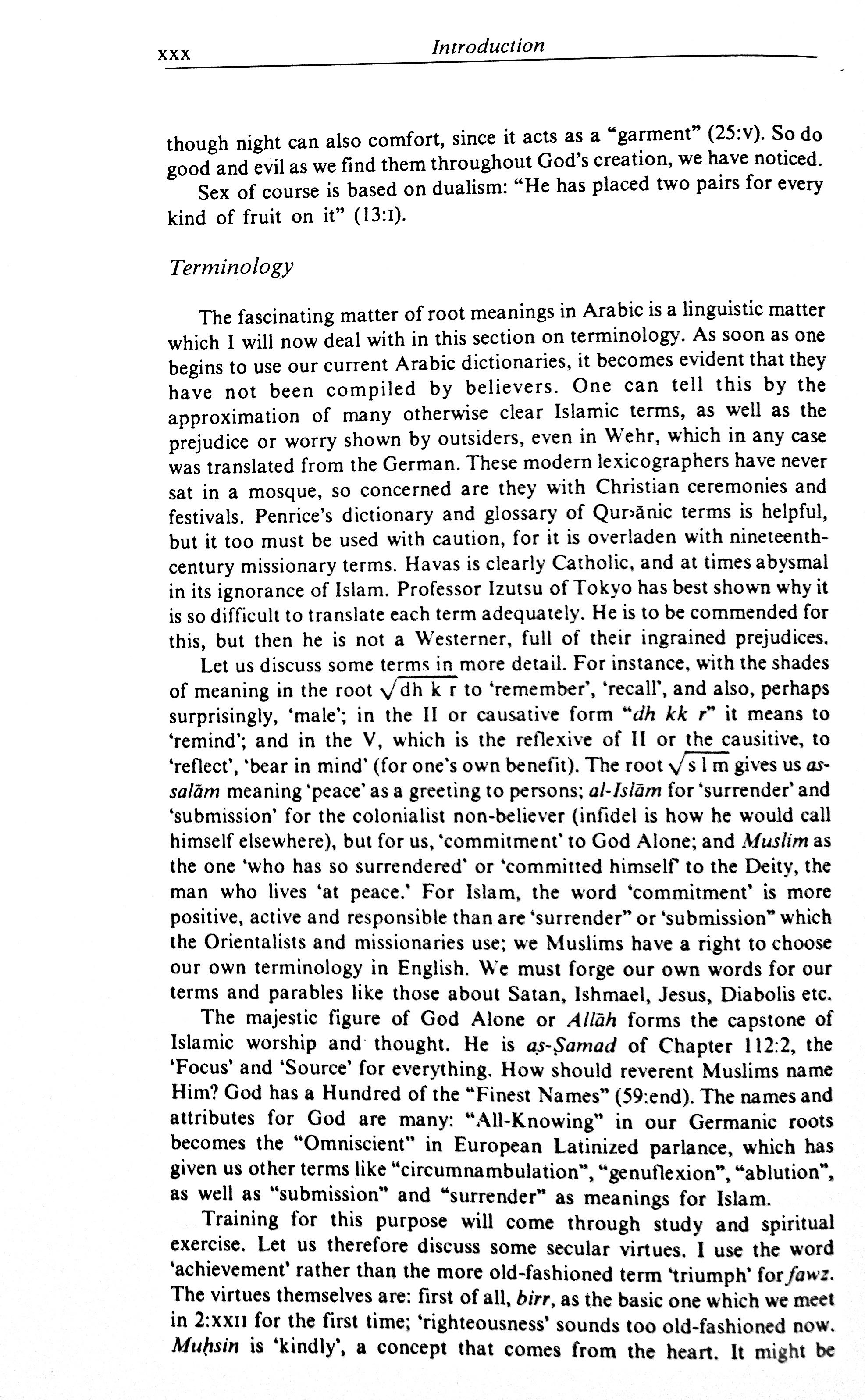
The fascinating matter of root meanings in Arabic is a linguistic matter which I will now deal with in this section on terminology. As soon as one begins to use our current Arabic dictionaries, it becomes evident that they have not been compiled by believers. One can tell this by the approximation of many otherwise clear Islamic terms, as well as the prejudice or worry shown by outsiders, even in Wehr, which in any case was translated from the German. These modern lexicographers have never sat in a mosque, so concerned are they with Christian ceremonies and festivals. Penrice’s dictionary and glossary of Qurʾānic terms is helpful, but it too must be used with caution, for it is overladen with nineteenth-century missionary terms. Havas is clearly Catholic, and at times abysmal in its ignorance of Islam. Professor Izutsu of Tokyo has best shown why it is so difficult to translate each term adequately. He is to be commended for this, but then he is not a Westerner, full of their ingrained prejudices.
Let us discuss some terms in more detail. For instance, with the shades of meaning in the root dh k r to ‘remember’, ‘recall’, and also, perhaps surprisingly, ‘male’; in the II or causative form “dh kk r” it means to ‘remind’; and in the V, which is the reflexive of II or the causitive, to ‘reflect’, ‘bear in mind’ (for one’s own benefit). The root s l m gives us as-salām meaning ‘peace’ as a greeting to persons; al-Islām for ‘surrender’ and ‘submission’ for the colonialist non-believer (infidel is how he would call himself elsewhere), but for us, ‘commitment’ to God Alone; and Muslim as the one ‘who has so surrendered’ or ‘committed himself’ to the Deity, the man who lives ‘at peace.’ For Islam, the word ‘commitment’ is more positive, active and responsible than are “surrender” or “submission” which the Orientalists and missionaries use; we Muslims have a right to choose our own terminology in English. We must forge our own words for our terms and parables like those about Satan, Ishmael, Jesus, Diabolis etc.
The majestic figure of God Alone or Allāh forms the capstone of Islamic worship and thought. He is aṣ-Ṣamad of Chapter 112:2, the ‘Focus’ and ‘Source’ for everything. How should reverent Muslims name Him? God has a Hundred of the “Finest Names” (59:end). The names and attributes for God are many: “All-Knowing” in our Germanic roots becomes the “Omniscient” in European Latinized parlance, which has given us other terms like “circumnambulation”, “genuflexion”, “ablution”, as well as submission and “surrender” as meanings for Islam.
Training for this purpose will come through study and spiritual exercise. Let us therefore discuss some secular virtues. I use the word ‘achievement’ rather than the more old-fashioned term ‘triumph’ for fawz. The virtues themselves are: first of all, birr, as the basic one which we meet in 2:xxii for the first time; ‘righteousness’ sounds too old-fashioned now. Muḥsin is ‘kindly’, a concept that comes from the heart. It might be