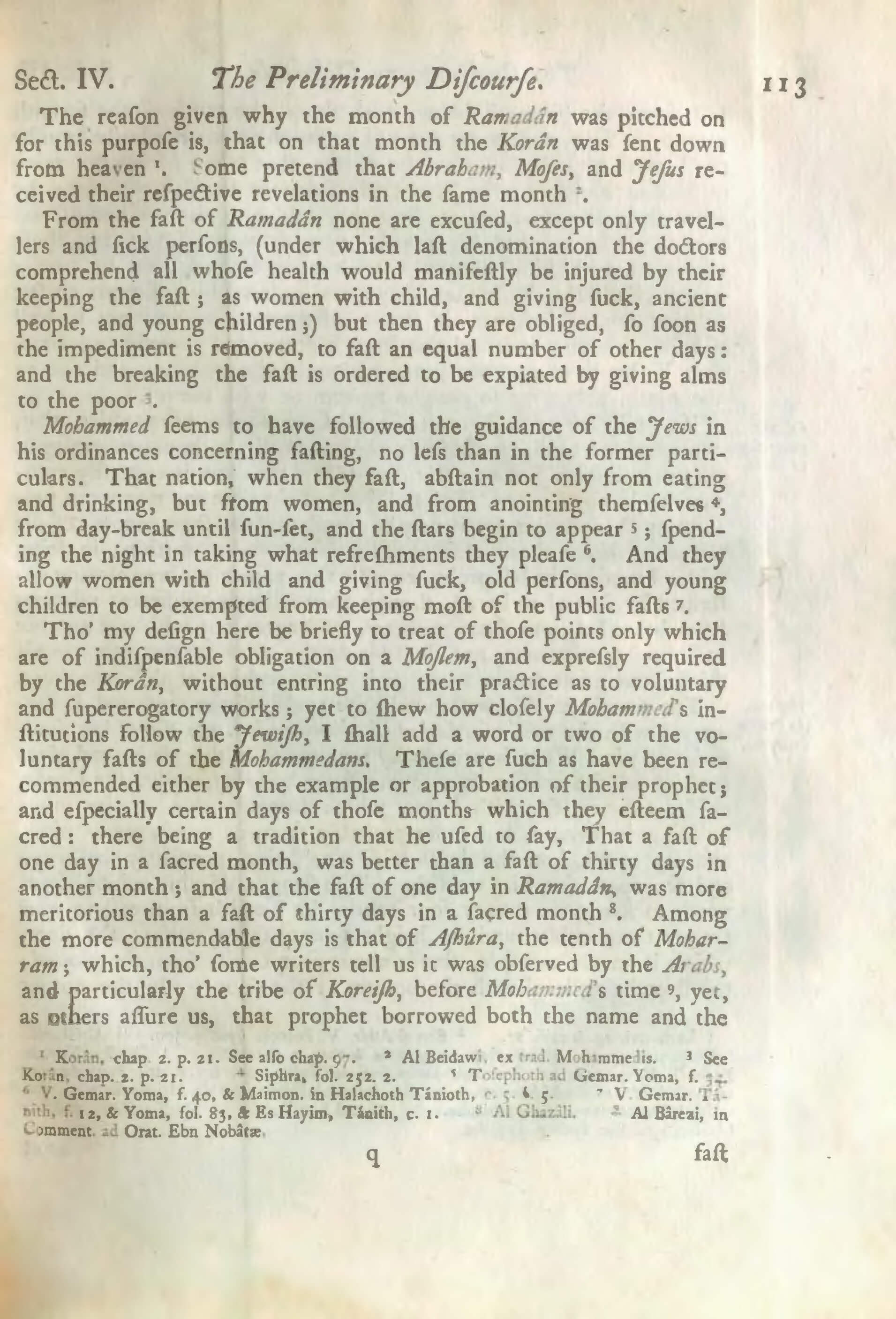
George Sale, The Koran, commonly called the Alcoran of Mohammed, translated into English immediately from the original Arabic; with Explanatory Notes, taken from the most approved Commentators. To which is prefixed A Preliminary Discource (1734)
The reason given why the month of Ramadân was pitched on for this purpose is, that on that month the Korân was sent down from heaven 1. Some pretend that Abraham, Moses, and Jesus received their respective revelations in the same month 2.
From the fast of Ramadân none are excused, except only travellers and sick persons, (under which last denomination the doctors comprehend all whose health would manifestly be injured by their keeping the fast; as women with child, and giving suck, ancient people, and young children;) but then they are obliged, so soon as the impediment is removed, to fast an equal number of other days: and the breaking the fast is ordered to be expiated by giving alms to the poor 3.
Mohammed seems to have followed the guidance of the Jews in his ordinances concerning fasting, no less than in the former particulars. That nation, when they fast, abstain not only from eating and drinking, but from women, and from anointing themselves 4, from day-break until sun-set, and the stars begin to appear 5; spending the night in taking what refreshments they please 6. And they allow women with child and giving suck, old persons, and young children to be exempted from keeping most of the public fasts 7.
Tho’ my design here be briefly to treat of those points only which are of indispensable obligation on a Moslem, and expressly required by the Korân, without entring into their practice as to voluntary and supererogatory works; yet to shew how closely Mohammed’s institutions follow the Jewish, I shall add a word or two of the voluntary fasts of the Mohammedans. These are such as have been recommended either by the example or approbation of their prophet; and especially certain days of those months which they esteem sacred: there being a tradition that he used to say, That a fast of one day in a sacred month, was better than a fast of thirty days in another month; and that the fas of one day in Ramadân, was more meritorious than a fast of thirty days in a sacred month 8. Among the more commendable days is that of Ashûra, the tenth of Moharram; which, tho’ some writers tell us it was observed by the Arabs, and particularly the tribe of Koreish, before Mohammed’s time 9, yet, as others assure us, that prophet borrowed both the name and the
1 Korân, chap. 2. p. 21. See also chap. 97.
2 Al Beidawi, ex trad. Mohammedis.
4 Siphra, fol. 252. 2.
5 Tosephoth ad Gemar. Yoma, f. 34.
6 V. Gemar. Yoma, f. 40, & Maimon. in Halachoth Tánioth, c. 5. §. 5.
7 V. Gemir. Tanith, f. 12, & Yoma, fol. 83, & Es Hayim, Tánith, c. 1.
8 Al Ghazali.
9 Al Bârezi, in Comment. ad Orat. Ebn Nobâtæ.